


How to Invest During a Recession
The Great Recession lasted 18 months, encapsulating the biggest economic downturn since the Great Depression in the early 1930s. Starting at the close of December 2007 and lasting through the beginning of summer 2009, the Great Recession is defined by high unemployment rates and soaring home foreclosures. Recessions are primarily financial, of course, but also carry critical costs for family matters. Over 16 million homes were lost, and the majority of those unemployed were out of work for nearly seven months.
Since the start of the COVID-19 pandemic, experts have warned of another potential recession. As prices continue to rise and supply chain concerns are taking longer to stabilize, everyone is looking for ways to save money and secure any part of their future they can.
Whatever the state of the economy, recessions are an unavoidable fact of life, so knowing how to prepare your investments for a recession is vital. At HSC Wealth Advisors, we can help you seek opportunities in economic strife and better prepare for the aftermath of a recession.
Ready to Invest Smarter During a Recession?
While challenging, recesions can present unique opportunities for savvy investors. At HSC Wealth Advisors, our experts specialize help individuals and families make informed investment decisions during economic downturns. Our services include:
View our full service catalog to learn how we can help you navigate market challeneges and prepare for long-term success!
Should You Invest During a Recession?
Contrary to popular thought, investing during a recession may be more fruitful than you realize. Despite your gut instinct to divest or shift from stocks to bonds, smart investing during a recession is a great opportunity.
Timing is important, and if not done properly, it can result in big losses. At the same time, timing is one of the primary reasons to invest during a recession. Investing is about buying profitable assets for less than they’re worth, and timing is just one wrench in the toolbox. Buy stocks when they are cheap but not the absolute cheapest.
During this time, be prepared to see your investments dip before they increase in value. Stay vigilant — this is normal, and your patience will reward you.

How to Invest During a Recession
Knowing what to invest in during a recession is just as important as deciding to invest in the first place. Diversify your investment portfolio over a variety of assets. It is unlikely that all the companies you invest in will go bankrupt at once. Whatever the market, your wealth will grow, and you won’t be putting all your money into one place. Mutual funds are one of the more advantageous fund types to use in a recession because of the diversification they allow.
To find the best investing strategy during a recession, seek out an experienced wealth manager. They have professional opinions on where to invest money and strategies for investing during a recession. A wealth advisor could also help prepare your portfolio for the next downturn. With their judgment, you can improve your net returns through smart wealth management.
How the Pandemic Affected the Economy
For more than two years, Covid-19 was an all-encompassing part of our daily lives. It affected everything from where we went to what we felt safe enough to do. This fact was reflected in the economy almost immediately, driving forth changes that affect the landscape of investing to this day.
These changes came up faster than ever. The pandemic seemed to take trends that were already starting to appear within the investment landscape and supercharge them. Young investors started joining the market at surprising rates. Mobile device trading enabled more people to invest from the comfort of their homes. Rapid trading became part of the norm.
As the stock market became even more tumultuous through various waves of COVID-19, people began to recognize the importance of diversifying their portfolios — and they found plenty of new avenues to pursue. The rise of cryptocurrency and new technologies had many rushing toward these high-risk, high-reward opportunities, hoping to secure an abundance of funds before rates started falling.
More than ever, foreign investments were seen as a major risk. Countries all over the world were buckling under the weight the pandemic was putting on their government, people and businesses. The prevalence of supply chain and shipping concerns to this day has made many investors slow to return to this sector, and many industries that were once considered “safe” have changed in their risk during these times.
What to Invest in During a Recession
While no investment is foolproof, certain industries are safer than others, generally due to consumer needs, regardless of financial security. Even with the reshuffling of priorities the pandemic caused, some stock industries continue to rank high above all else. Some of the safest places to put your money in a recession are:
- Health care: The health care sector and related industries are overall considered “recession-proof.” Regardless of the economy’s state, people have health conditions to manage, and they experience accidents requiring medical intervention. Health insurance is something most people will not want to skimp on if they can avoid it, as during the most tumultuous periods of the economy, anything can happen.
- Food services: Like health care, food is one of the essentials of life and is something everyone must spend money on. While grocery stores and restaurants were previously considered safe investments, the pandemic has changed minds with so many restaurants forced to close their doors. However, big-name fast food restaurants with established fan bases and cheap meal options are still good investment choices during a recession.
- Technology: With the push for at-home work at an all-time high, people are spending more money investing in their home offices. They are upgrading their technology and buying equipment that will help them better do their jobs.
- Home improvement: Similar to why people are investing in technology, individuals are spending more time at home than ever, encouraging them to optimize their space to improve their lives. They are learning to repair things themselves and discovering new DIY project opportunities instead of paying someone else to do them. Ultimately, any industry that can help cut costs is a good investment during recession times.
- Discount retail: As prices start rising, people use every route available to save money. Dollar stores and discount grocers become more popular during recessions, as they provide most household necessities at a reduced price compared to your normal grocery and home goods stores. Investing in discount retail providers is a great short-term investment plan, allowing you to grow your investment quickly during the recession and double down on your efforts in new areas once the economy stabilizes.
Try to invest in businesses in each of these industries. Between their recession-hardy nature and your wide variety of investments, you give yourself the best opportunity to grow your stocks and come out of an impending recession better off than you were before. A good wealth advisor will take you through your options and help you make the best choice for your preferences.
Low-Expense Investments and ETFs
Similar to mutual funds, exchange-traded funds (ETFs) are registered with the government under the United States Securities and Exchange Commission (SEC). ETFs permit investors to pool money in a fund that makes a combination of investment types such as stocks, bonds or other assets. They differ from mutual funds in that they are traded through national stock exchanges. The individual shares of ETFs cannot be sold or redeemed directly from retail investors.
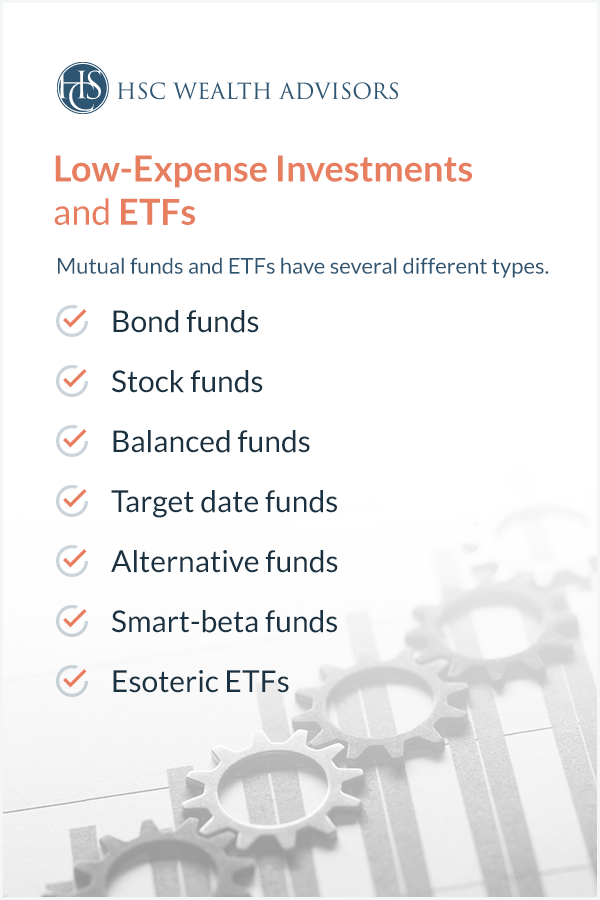
Mutual funds and ETFs have several different types. There are bond funds, stock funds and a combination of these types including alternative funds, target date funds, balanced funds, smart-beta funds and esoteric ETFs.
- Bond funds: A bond fund, or debt fund, invests in bonds or other debt securities. Mortgage-backed securities are one kind of bond fund. Bond funds have so many different types that it is difficult to assess the overall risk. Some of the principal risks of bond funds are associated with credit, interest and pre-payment.
- Stock funds: Stock funds, or equities, change quickly over any given term. The welfare of the economy affects the fluctuation of stock prices. Stock funds are subject to market risk.
- Balanced funds: Also called asset allocation funds, balanced funds have both a stock and market component. This reduces risk while also leveraging capital gains. Balanced funds have a fixed allocation for each investment type.
- Target date funds: Designed with an expiration date in mind, target date funds work well for investors who are planning to retire. For this reason, they are also called target date retirement funds or lifecycle funds. As the target date approaches, the investment type of this fund becomes more conservative.
- Alternative funds: This fund type invests in non-traditional trading strategies like real estate, private debt or leveraged loans. They offer more liquidity and diversification.
- Smart-beta funds: Smart-beta funds are like index funds, which have lower expenses and are passively managed by replicating the current financial market. Instead, smart-beta funds rank stock based on risk and return, deriving better returns than traditional index funds.
- Esoteric ETFs: These funds narrow in on niche investments. They are also called exotic funds. Esoteric funds usually involve complex investments with higher expenses.
Unlike for-profit mutual funds companies that only care to maximize profit, HSC Wealth Advisors is obligated to work solely on your behalf. We use appropriate low-expense investments by choosing ETFs and mutual funds with no load and no transaction fee. Mutual fund companies highlight high-expense products that will earn them the most profit but usually underperform in the long run.
HSC takes two steps in investing in a mutual fund. The first is selecting the fund. The second is selecting the share class. In choosing the fund, HSC considers consistency of style and composition with asset class as well as the stability of the organization. Naturally, we’ll take a close look at risk performance too.
In choosing the share class, we consider expense ratios/fee, absolutely and in relative terms to peers. For your sake, we’ll also look for share classes that do not have transaction fees or initial or deferred loads. We want to make sure these share classes have initial investment minimums that we can meet. In this way, we cater to your specific needs.
Longterm Asset Allocation Strategy

Reactionary changes do not yield long-term results. Investors who do not have the diligence for long-term strategies fare worse in the market overall. Managing your investment portfolio during a recession begins by making smart investing decisions. One way to do this is by working with a professional wealth management advisor. An investment advisor with expertise can coach you through strategy, risk tolerance and financial goals to ensure that you make the appropriate investments for you.
At HSC Wealth Advisors, our wealth advisors assess the volatility of your portfolio over your life and determine your capacity to tolerate the changes in the market. We can express this measurement quantitatively as well as stimulate your rate of return using predictive software.
An advisor can also enlighten you on your time horizon. We can strategize your portfolio based on what phase of life you’re going through. Perhaps you want to know how to prepare a retirement fund for a recession. Or you may be in the accumulation phase of life and need to wait several years before your portfolio is financially viable.
We can provide authentic answers about your withdrawals and savings. Simply asking when you will add or withdraw from your portfolio is not as useful as asking how much you will withdraw or add. Our process accounts for that.
In addition, our team looks into the legal situations that might surround an investment. We can make sure you will not face any trouble head-on. This includes any tax laws that pertain to your investments. Choosing the right accounts for your investments, knowing when to sell and picking an investment with only slight tax implications will increase your return.
Our strategies cater to your unique circumstances. We do not push one agenda over another. What works for someone else does not inherently work for you.
Successful Investment Strategies
If you are unsure where to start, consider the following strategies and techniques to diversify your portfolio and enhance your return on your investment. In other words, these options can be a great foundation for getting rich during a recession.
Fixed-Income Recession Strategies
Fixed income describes a type of investment in which investors earn fixed interest payments until maturation. Once matured, the investor will be paid back the principal amount they originally invested. Corporate and government bonds are the most common fund types in this category.
Fixed-income security types are appealing to investors who prefer conservative investing strategies. In addition to being virtually risk-free, they can be an effective investment portfolio strategy during a recession. They diversify your portfolio, and you are guaranteed to get a return on your investment. Fixed-income security types can be any of the following:
- ETFs
- Treasury bills
- Treasury notes
- Treasury bonds
- Treasury inflation-protected securities (TIPS)
- Municipal bonds
- Corporate bonds
- Junk bonds
- Certificates of deposit (CDs)
- Mutual funds
- EFTs
Rebalancing Portfolios

Wondering how to prepare for a recession if you are retired? Rebalancing might be part of your future plans, starting with adjusting the assets in your portfolio. You can buy or sell your assets depending on your desired level of risk or asset allocation.
Along with creating an investment plan that aligns with your goals, a wealth advisor will rebalance your portfolio, helping you keep your eye on long-term strategies rather than letting you divest early. Part of your financial advisor’s role is to remove emotions that are not conducive to your portfolio. To illustrate, sometimes rebalancing involves selling assets that are on the rise and reinvesting the earnings into receding assets. A wealth advisor will provide their knowledge and recommend the most effective way to keep you on target.
When looking for a financial advisor, choose a fee-only firm. These fiduciaries will have no conflicts of interest and are only concerned with helping you reach your objectives, not coercing you into making certain investments or meeting some predetermined quota of trades.
Investing for the Recovery
The main advantage of investing during a recession is reaping the benefits during the recovery. Although we do not always know when recessions will end, we know the market will recover. Therefore, it is in your best interests during a recession to invest in long-standing, high-quality companies that will survive instability in the market. After all, stock investments are meant to be long-term.
When markets begin to improve, you will see your investments pay off. This is also a good time to analyze your investment portfolio and perhaps start selling assets. Create a plan or seek out a financial advisor to help you determine when you should be trading.
Why Choose HSC Wealth Advisors for Investment Help?
Reactionary changes do not yield long-term results. Investors who do not have the diligence for long-term strategies fare worse in the market overall. Managing your investment portfolio during a recession begins by making smart investing decisions. One way to do this is by working with a professional wealth management advisor. An experienced investment advisor can coach you through strategy, risk tolerance, and financial goals to ensure you make the appropriate investments for you.
At HSC Wealth Advisors, our wealth advisors assess the volatility of your portfolio over your life and determine your capacity to tolerate the changes in the market. We can express this measurement quantitatively and stimulate your rate of return using predictive software.
Specifically, we can:
- Cater to unique circumstances: Whether you are preparing for retirement or building your portfolio, HSC Wealth Advisors can strategize your portfolio based on your current phase of life.
- Provide authentic answers: Our process accounts for your withdrawals and savings and will help guide you through how much to withdraw or add.
- Look into legal situations: Our team monitors legal situations that may surround your investments, helping you choose the right accounts and eliminating the risk of facing trouble head-on.
Let Us Help You Build for the Future

Up to 70% of adults in the United States working with a financial advisor feel ready for a recession, compared to 40% of adults who do not have a dedicated advisor. Those with strategic financial plans were able to save nearly three times as much for their retirement as those without, even during times of great economic uncertainty.
HSC Wealth Advisors is a fee-only firm that has been employing certified professionals in wealth management for over 40 years. Our financial advisors will work with you to design a financial plan that is personalized for your situation.
Tell us your financial goals, and we will help bring them to life.

Joe is a CERTIFIED FINANCIAL PLANNER professional, Accredited Investment Fiduciary®, Fellow, with distinction, of LOMA’s Life Management Institute, NAPFA-Registered Financial Advisor, and has a Chartered Financial Analyst (CFA) designation. He is a graduate of the University of North Carolina at Chapel Hill, AB College for Financial Planning, and holds an MBA from Wake Forest University, The Babcock School.